thomas
deckker
architect
critical reflections
Was Brasília inspired by a Jeep?
2026
2026

What did Lucio Costa think of China?
2024
2024
Did Lucio Costa know the Queen Mother?
2022
2022


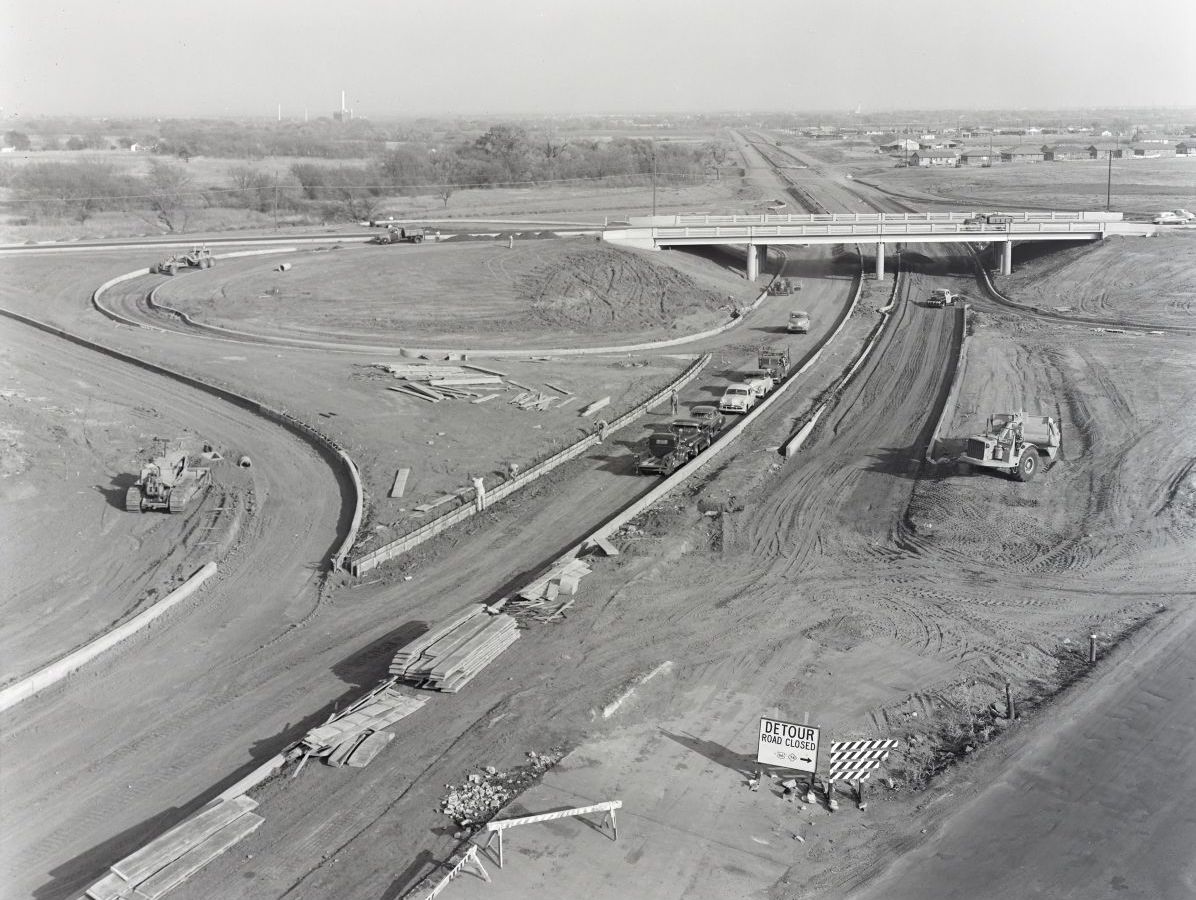
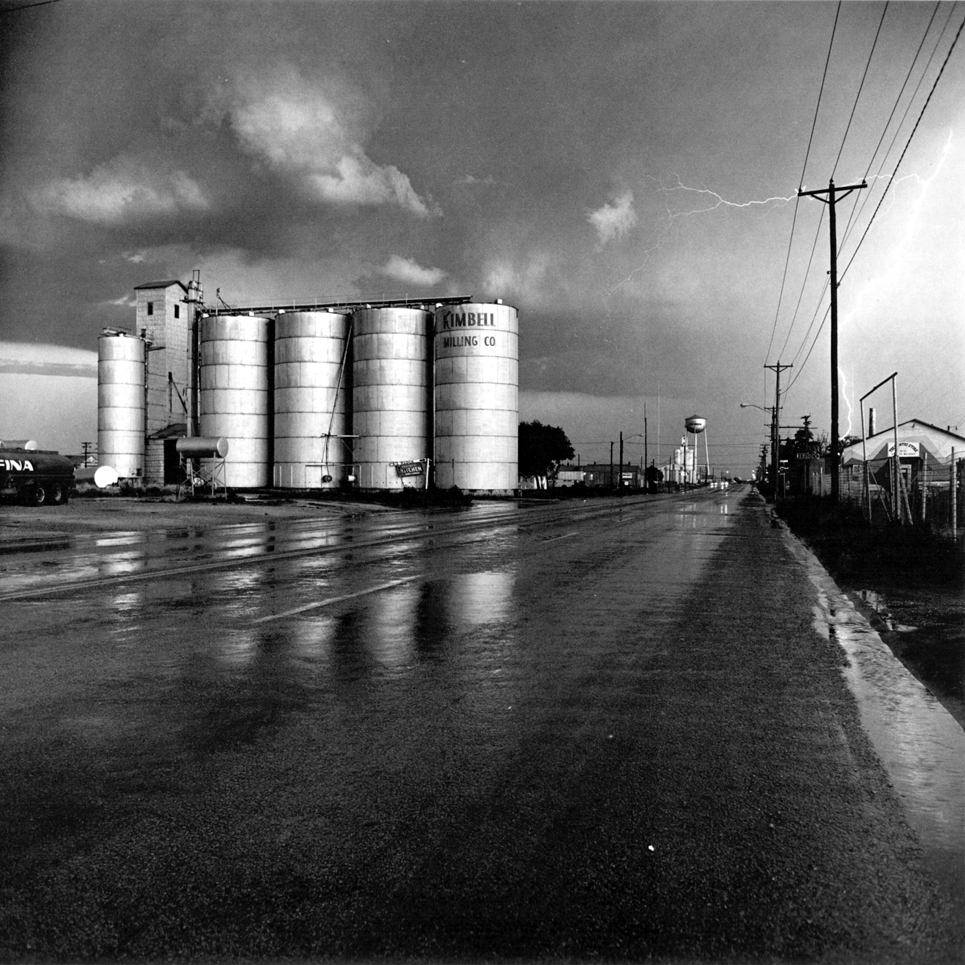
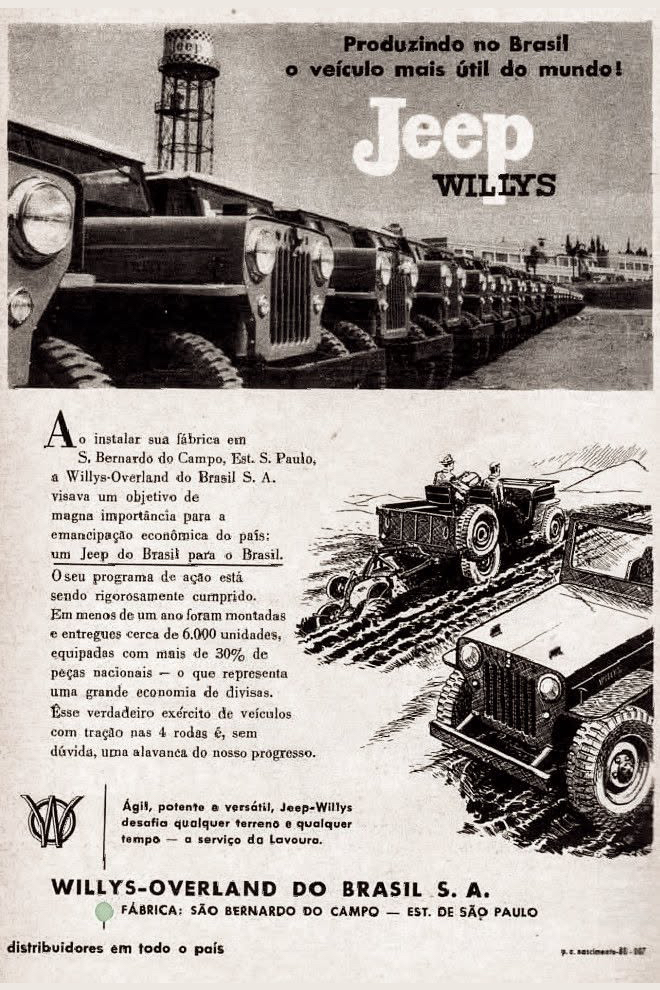
Advertising Poster for Willys Overland do Brasil 1956
The Willys Jeep was an iconic vehicle of WWII. It had a short life after WWII that overlapped in a significant way with the founding of Brasília in 1956.
Was Brasília inspired by a Jeep?
Up to a point, yes. It is commonly supposed that some unseen force emanating from CIAM created the city without any assistance from human beings. In fact, before Brasília was an architectural city, it was a political city, the vision of Juscelino Kubitschek, President of Brazil from 1956-60. In popular lore, Kubitschek spontaneously committed himself to a new capital city while on the campaign trail. In reality it was part of his campaign for the modernisation and industrialisation of Brazil, and he could look to friends in the United States for reassurance that not only was building a new city - that is managing a building site in virtually uninhabited territory with unskilled migrant labour - possible, but that they had done it, with great success, already.
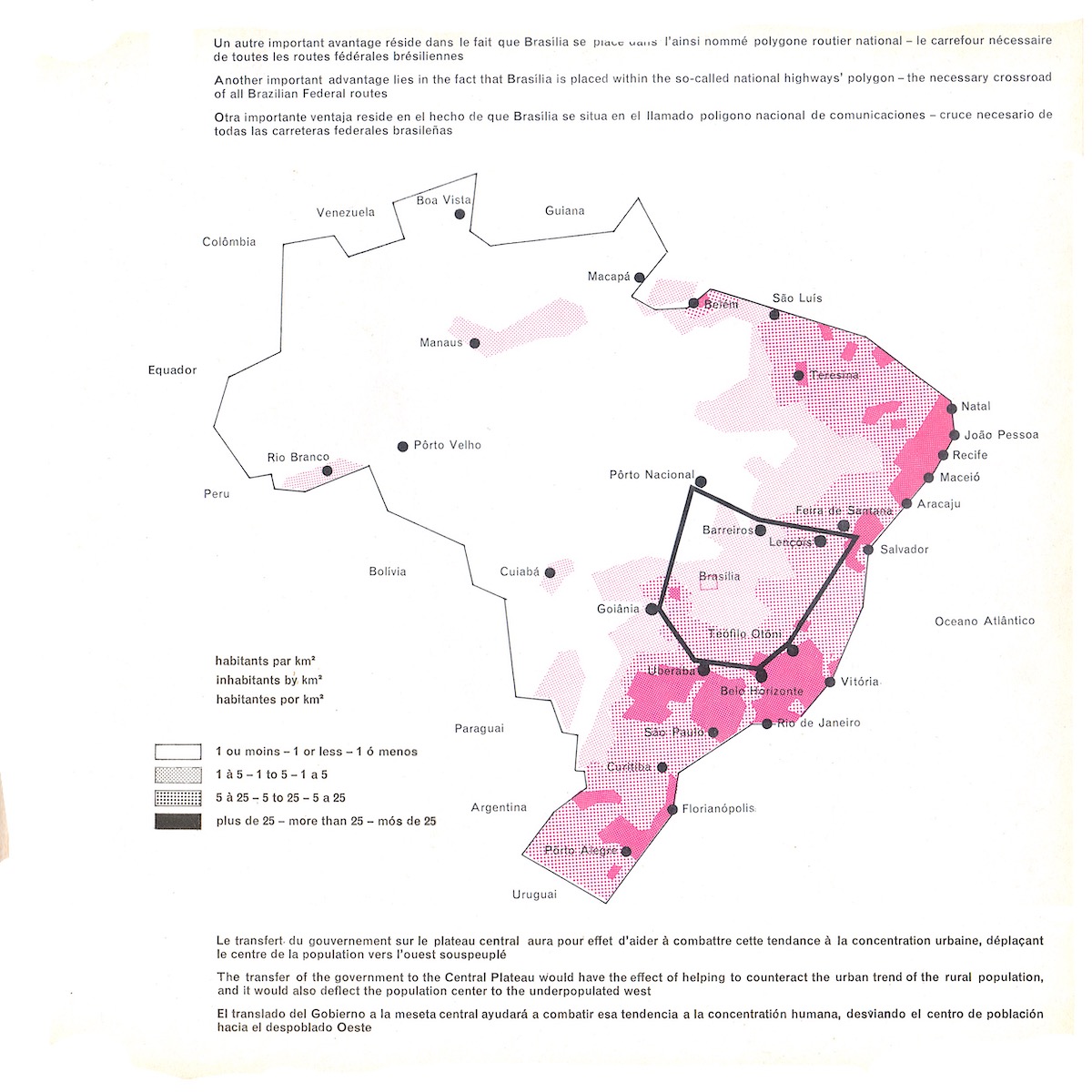
Map of the new road network to accompany the construction of Brasília
from ‘Brazil Builds a New Capital’ [1]
from ‘Brazil Builds a New Capital’ [1]
The 'national highways polygon' is wishful thinking. The highway network is concentrated on São Paulo and Rio de Janeiro; the connection to Porto Nacional from Goiânia (BR153), although eventually built, never gained importance, and from Salvador is mostly State roads (BA460/TO040).
In 1956, Kubitschek, as part of his programme of modernisation and industrialisation, devised a Plano de Metas [Plan of National Development], of state-sponsored development, intended to develop “fifty years of development in five". It closely resembled the New Deal, the programme put in place by Franklin D. Roosevelt to shepherd the United States out of the Depression. The administration of the New Deal showed the ability of experts to cut through political problems in industrial development and housing, and was part of a 'managerial revolution' that had spread from corporations such as General Motors (with whom Kubitschek also maintained strong relations) into the Federal government in the 1930s:
The program of national development of President Juscelino Kubitschek, developed with the studies and opinions of the greatest specialised authorities in each subject, consists of a series of sectorial investment programs, aimed at guiding the execution of works and expanding or implanting industries and services indispensable to the balanced economic development of the country. [2]
The combination of politicians and industrialists working for the common good seems to belong to another world, but it can be linked, historically, to the brief period of unchallenged prosperity and stability in the United States following the New Deal. In Brazil that link, forged so optimistically during WWII, ended abruptly with American support for the military coup in 1964. Writing in 1992, Elizabeth Anne Cobbs, in The rich neighbor policy: Rockefeller and Kaiser in Brazil, puts the situation as:
Today it is difficult to believe that anyone could have had faith in the power of private enterprise or even of the U.S. government to bring about significant positive change in the economies and social structures of Latin America. [3]
Nevertheless, however cynical and imperfect, this happened, and Kubitschek formed a close relationship with the industrialist Henry J Kaiser. Kubitschek was passionate (and quite correct) in believing that an indigenous industrial base was necessary for the development of Brazil, rather than exchanging agricultural exports for ready-assembled vehicles or kits from abroad. He followed the strategy of Roosevelt in the New Deal by setting up an administrative agency (such as the Tennessee Valley Authority), the Grupo Executivo da Indústria Automobilística (GEIA) [Executive Group for the Automobile Industry], in 1956, with financial incentives for indigenous car companies. The first company to submit a proposal was Willys-Overland do Brasil; the first vehicles were produced early in 1957.

Jeep Assembly Diagram
The Jeep was developed by Willys-Overland from a prototype by Bantam Motors, and produced from 1940. In the highly mobile theatres of war, dependent on the easy and rapid movement of men and materiel, the Jeep was of fundamental importance. By 1944, as war production ramped down, the CJ2A Jeep was marketed as a light tractor for agricultural use. [4]
Why Kaiser?

Richmond Shipyards, California
Edward Cochrane, Navy Department Bureau of Ships, Public domain, via Wikimedia Commons
Edward Cochrane, Navy Department Bureau of Ships, Public domain, via Wikimedia Commons
The shipyards are in the foreground, with workers housing in the background. Atchison Village is in left background.
The Jeep had come to the attention of some of the most politically powerful and well-connected families in Brazil during WWII: Oswaldo G. Aranha, son of Oswaldo Aranha, Brazilian Ambassador to the United States in 1934, Foreign Minister from 1937 and later President of the UN General Assembly in 1947, and Lucio Meira, Admiral in the Brazilian Navy and later Minister of Transport and Public Works under Kubitschek. Oswaldo G. Aranha, serving in the Brazilian Expeditionary Force in Italy in 1944, found the Jeep a revelation which he thought would be ideal for Brazil. He set up Willys-Overland do Brasil in 1952, with the politician and industrialist Theodoro Quartim Barbosa (a "financial associate and friend of Nelson Rockefeller", according to Cobbs), in association with the American industrialist Henry J Kaiser who at that time did not own Willys-Overland. Their break came when Kubitschek was elected President in 1956 and set up the GEIA. In the small and tight circles of Brazilian politics in the 1950s we can assume that Kubitschek, Meira and Barbosa were not only allies but personal friends, and this warmth and trust extended to Henry J Kaiser as well. [5]
Henry J Kaiser had come to prominence in the United States as head of the consortium that built the Hoover Dam during the Depression. During WWII he set up Kaiser Shipyards, 4 of which were in Richmond, California, which established records for the production of Liberty and Victory ships. In 1945 he set up a car company, Kaiser-Frazer Corporation, later Kaiser Motors, and bought Willys-Overland Motors, manufacturers of the Jeep, in 1953. Kaiser-Frazer could not compete with the big manufacturers for luxury cars, and the demand for Jeeps was declining, so the company began to slide into bankruptcy. In 1954 Kaiser went on tour of Latin America to expand exports of Jeeps to reduce debt. He found a welcome home in Brazil: Kubitschek wanted basic cars fabricated from raw materials, not assembled from imported components, and Kaiser wanted to off-load the tooling, that is the dies and presses, for Jeeps. To cap it off he already had Brazilian partners at the highest levels of finance and government ready to take advantage of the incentives of the GEIA. This 'golden age' lasted until the military coup in 1964, which brought very different attitudes in government to international commerce and the closure of the GEIA.
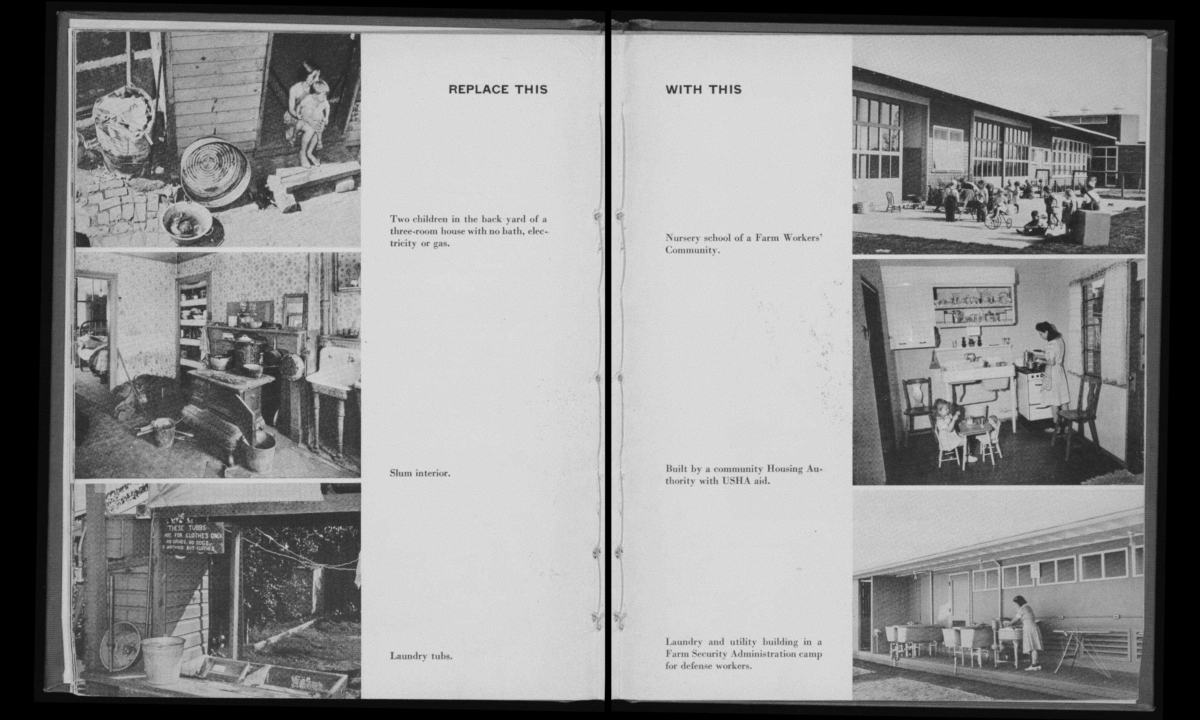
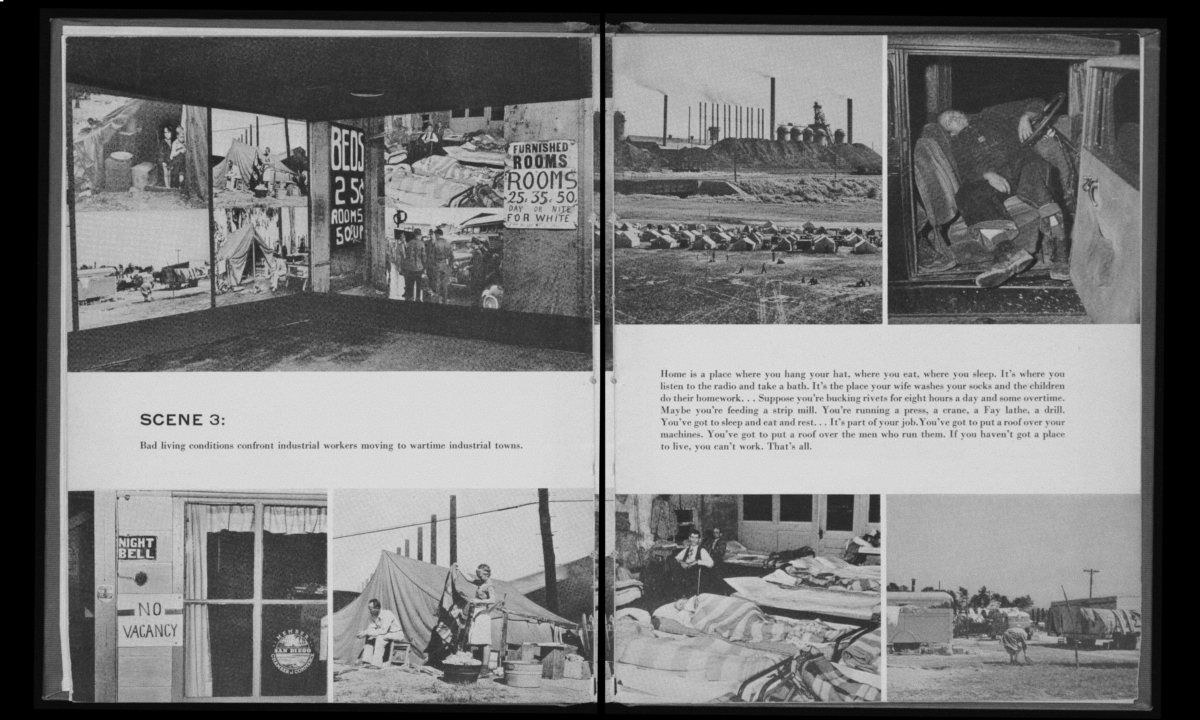
Wartime Housing (The Museum of Modern Art, New York 1942) 4 Volume IX May 1942
The Museum of Modern Art, New York was strongly allied to the war effort in the United States through Nelson A. Rockefeller, President of the Museum in 1939 and Coordinator of the Office of the Coordinator of Inter-American Affairs in 1941. The President of the OCIAA was Wallace K. Harrison, who had been an architect on the Rockefeller Centre, New York and the New York Worlds Fair, and would be executive architect for the Rockefeller-funded United Nations Headquarters, New York in 1947, for which Oscar Niemeyer was the design architect. In Spring 1942 the Museum was planning their 'Brazil Builds' exhibition and was in communication with Gustavo Capanema, the Minister of Education who had commissioned the celebrated Ministry of Education Building in Rio in 1936 designed by Lucio Costa and Niemeyer. It is inconceivable that Costa and Niemeyer were not aware of this catalogue, as they had met Wallace K. Harrison as architects of the Brazilian Pavilion at the New York Worlds Fair and were celebrated in the 'Brazil Builds' exhibition. The illustrations show the exaggerated dichotomy inherent in Modernism between the liberal and planned environments.
Kaiser was no raw capitalist. He realised that successful production in the shipyards rested on good living conditions for the workers, most of who had come to California specially to work on war commissions, and established a health care trust, Kaiser Permanente. Workers lived initially in what was considered a shanty-town. He established housing for his shipyard workers such as Atchison Village, Richmond’s first public defense housing project. This was one of the few projects funded by the Community Facilities Act of 1940 (the Lanham Act). He continued developing “model suburbs” after the end of WWII, setting up Kaiser Community Homes as a development company. Panorama City, Los Angeles, for example, was built adjacent to the General Motors Van Nuys Assembly Plant (active 1947-92). Three thousand homes were built between 1947 and 1952, using funding from the Federal Housing Administration and the Servicemen's Readjustment Act (1944). In other words, Kaiser showed that high-quality housing could be built at short notice to support a major industrial enterprise.
Why not Kaiser?

Katherine Archibald: Wartime Shipyards (University of California Press 1947). Illustrated with photographs by Dorothea Lange. Dorothea Lange's copy.
Subtitled 'A Study in Social Disunity' Wartime Shipyards exposed as a myth that better housing led to better industrial, social and race relations.
It was a central part of the ideology of the Modern Movement, and housing reform movements in the United States, that Modern housing would not only provide high quality homes - which it actually did in some cases - but also solve social problems. This was explicit in publications like America can't have housing, published by the Museum of Modern Art, New York in 1934. The New York City Housing Authority was also established in 1934, when it engaged in a campaign of slum clearance to support a reduction in crime.
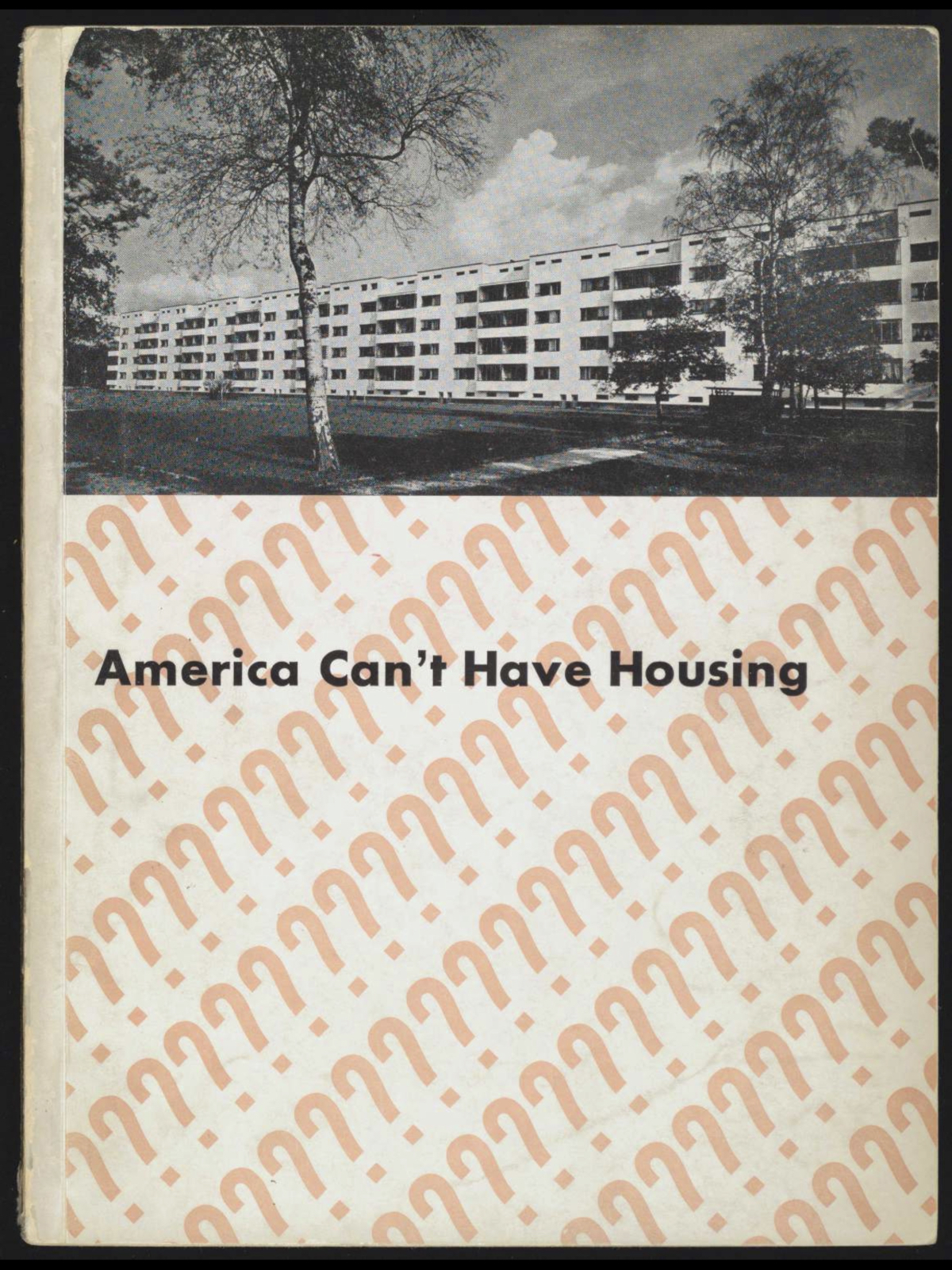
America can't have housing (The Museum of Modern Art, New York 1934). The cover illustration was the Siemensttadt Housing, Berlin (1929-34), designed by Walter Gropius to a masterplan by Hans Scharoun. Gropius left Germany in 1934, passing through England to the United States. The quality of his design work after WWII unfortunately descended into kitsch which has been overlooked to preserve his reputation as a Master of the Modern Movement.
Conditions for workers at the shipyards were regarded as unacceptably poor. The noted photographer Dorothea Lange, a beneficiary of New Deal artistic programmes, had documented migrant camps during the Depression and documented life in the shipyards which she thought of as symbols of American recovery. While Lange portrayed life in the camps as utopian - and it may have been for many migrants from the poverty-stricken southern and central States, prosperity does not seem to have been applied equally. In 1942, a young graduate student, Katherine Archibald, went undercover in the Richmond Shipyards which led to her book Wartime Shipyard: A Study in Social Disunity. As the equation of housing and social stability was a central plank of housing reform, and Modern Movement theory, this book was largely ignored.
As I became adjusted to my new environment, I discovered that the magnitude of fact dwarfed my simple preconceptions. Where logic and liberal theory had promised some sense of unity among the shipyard workers, derived from their common interests and common status, I found in actuality differences and gaps - social abysses so deep that the possibility of spanning them never occurred, apparently, to right-minded people reared after a righteous custom. I found intolerance of slight linguistic and cultural differences so great that the ghosts of feudal snobbery seemed to have come alive. I found insularities so narrow as scarcely to be believed. Even among these people, for whose sake the liberal had contrived his dream of equalitarianism, I found that the lesser inequalities were cherished, and the weaker suppressed by the less weak. Where I had confidently expected unity of purpose and of action, I found only antagonism and turmoil. [6]
Wartime Housing (The Museum of Modern Art, New York 1942) 4 Volume IX May 1942
The Museum of Modern Art, New York was a determined advocate for Modern housing in the United States, with exhibitions and publications such as America can't have housing (1934), Architecture in government housing (1936) and Wartime Housing (1942). While doubtless portraying actual scenes these photographs do not celebrate the dynamic and liberal economy that had captivated European observers.
What's this got to do with Brasília?
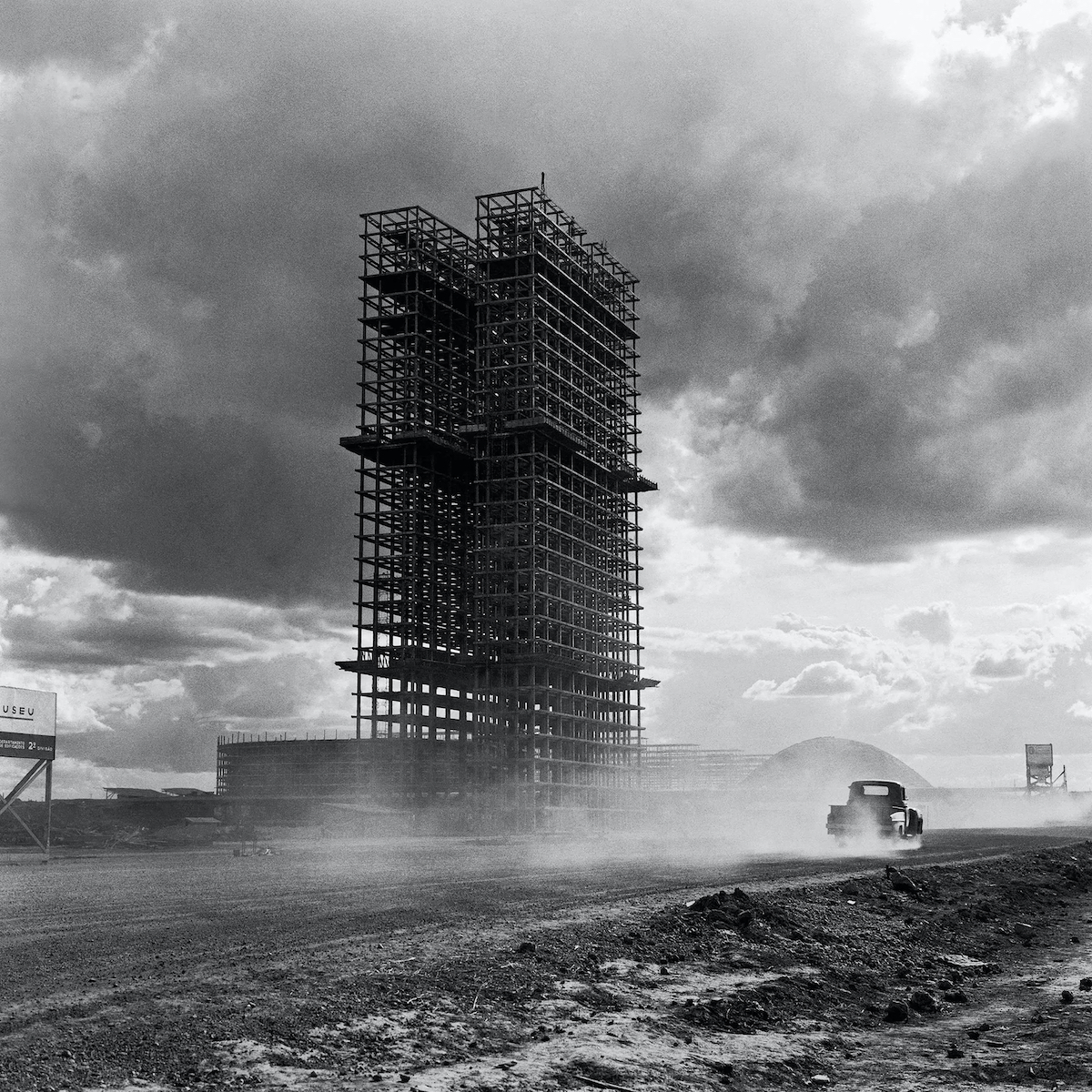
The Congresso under Construction, 1958
photo © Marcel Guatherot
photo © Marcel Guatherot
Marcel Guatherot's photographs are a unique record of both the struggle to build Brasília and the utopian vision of its completed works.
Brasília, like the Richmond Shipyards, was a totally new construction site dependent entirely on unskilled internally migrant labour. The workforce had to be housed, fed and entertained. The first wave of labour made their own housing in the Cidade Livre. This was never intended to be a permanent settlement, but, like a very substantial amount of housing in Brasília, temporary or unofficial occupation of the land forced official acceptance. The Cidade Livre had of necessity to provide a multiplicity of functions totally outside planning orthodoxy. Niemeyer remembered the Cidade Livre as:
the ‘wild west’ of the new capital. A wide street covered in mud, full of jeeps, horses and carts, lined with low constructions of brickwork, where the bars, restaurants, night-clubs and the prostitutes of the city were to be found. [7]
It is commonly supposed that there was a conspiracy against the Cidade Livre. However, only six months after the opening of the building site, there was official recognition and appreciation of a viable informal city:
what came to be known as the "Cidade Livre" (Free City) had sprung up — a settlement of shops and homes erected on a tract of land under short-term permits, without any long-term commitments. Under these conditions, businesses of every kind proliferated, ranging from stores selling basic necessities and butcher shops to the hotels essential for accommodating a transient population. Brasília thus boasted over 300 wooden structures, built at the owners' expense to meet the population's every need. Suffice it to say that — in full operation, I believe — there were already three modern bakeries. The four established pharmacies stocked all the medicines found in major cities. Meals at the hotels and restaurants were satisfactory. The presence of branches of several national banks served as an indicator of the city's expansion. And all of this was achieved through private enterprise — or, rather, through widespread confidence in Brasília’s future. This wooden city heralded the grandeur and growth of the other city, whose foundations were already being laid for steel and reinforced concrete structures. It was more than just an incentive to continue the work; it was a guarantee of that continuation, demonstrating that over 6,000 Brazilians — having answered Brasília’s call — were there to refute every defeatist argument regarding the remote location, the lack of natural resources, or the impossibility of sustaining a human settlement in that part of the Brazilian hinterland. [8]
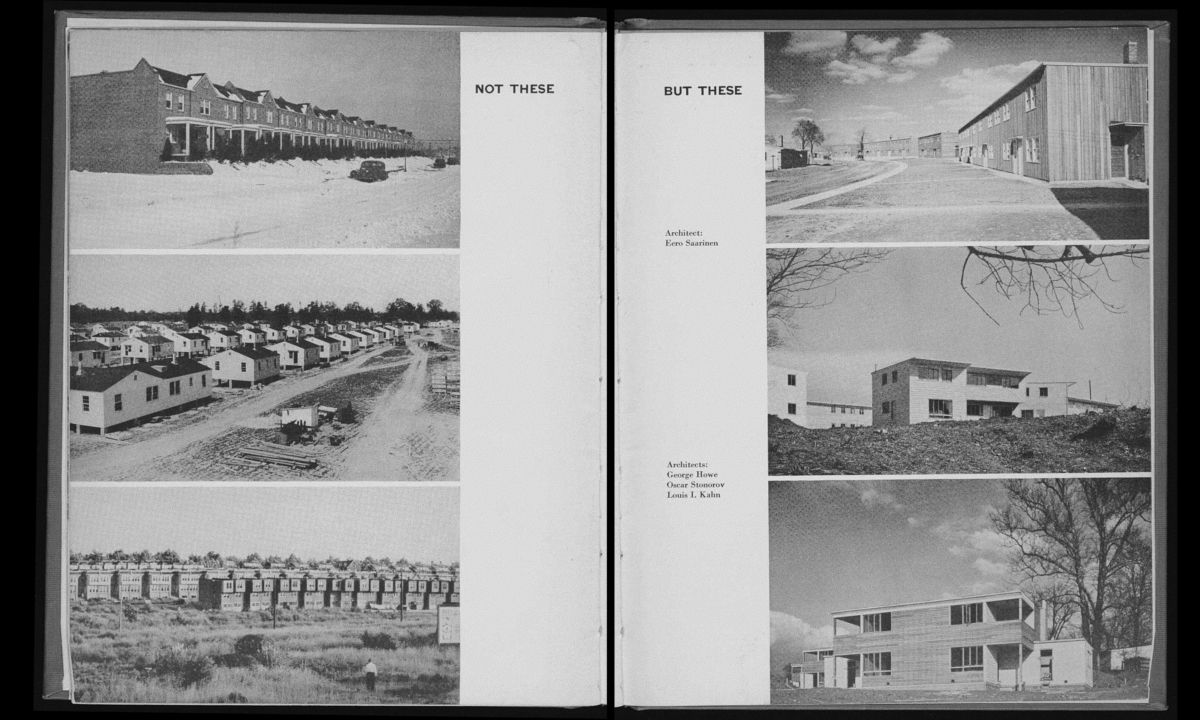
Wartime Housing (The Museum of Modern Art, New York 1942) 4 Volume IX May 1942
The resemblance of the 'BUT THESE' Modern Movement houses to the social housing built along the W3 in Brasília is striking, and in contrast to the individual private houses similar to the 'NOT THESE' built in the contemporaneous satelite city of Taguatinga. Unfortunately, as the social housing has been transferred to private ownership, it has lost its utopian characer completely.
To be clear, the long term existence of an informal city such as the Cidade Livre, however expedient and vital in the short term, was clearly offensive to the political establishment in Brasília, as much as it had been in Richmond, because for many years it had been considered inappropriate to house workers in shanty towns. By 1958 workers housing had been built along the W3 adjacent to the superquadras, and the first satellite city, Taguatinga, planned.
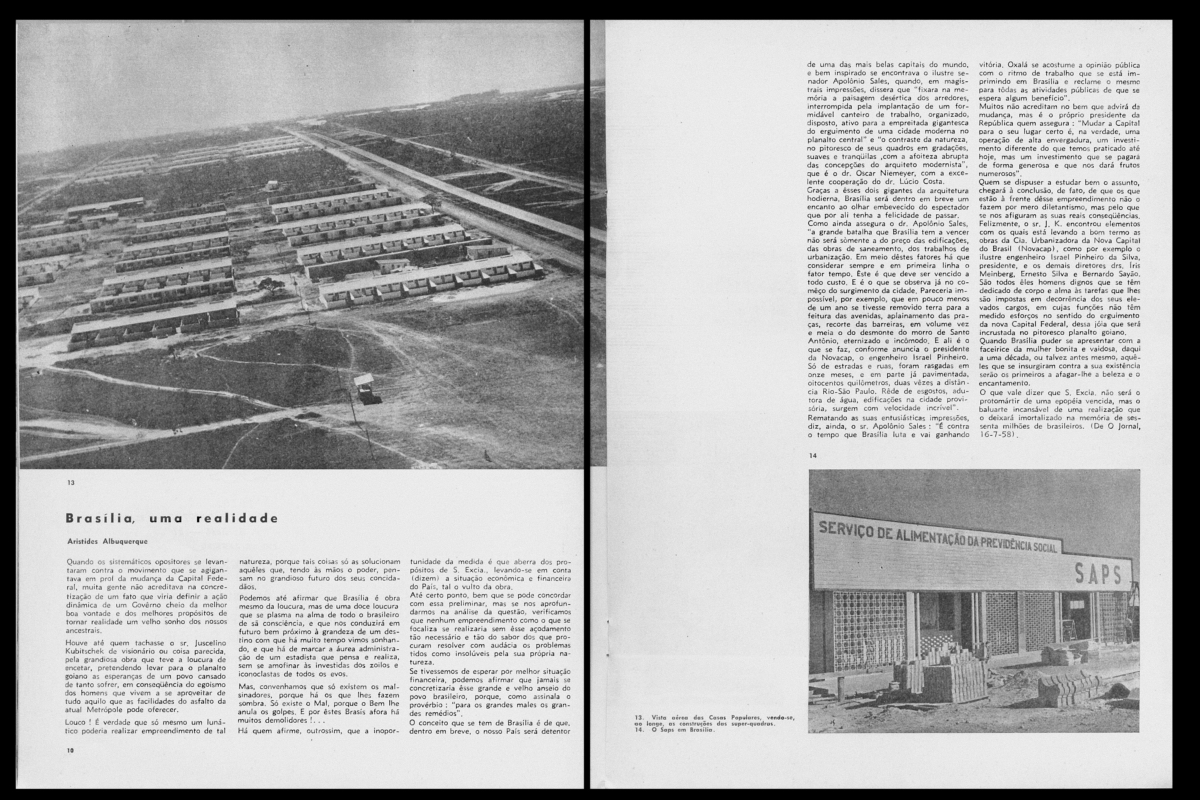
brasilia No 19 (1958) pp.10-11.
Social Housing along the W3, which separates them from the superquadras, as yet unbuilt. Far from entire city built in 3 years, as is commonly supposed, only 6 superquadras were built in the asa sul by 1960. Note the similarity of the SAPS - a subsidised canteen - with the "WITH THIS" communal facilities from Wartime Housing above.
Kaiser, and Jeeps, clearly had no influence on the architectural city of government buildings or the flagship superquadra housing blocks. The political city, however, was tied up in policies of industrialisation which only a few years previously, and certainly in the recent experience of the politicians and businessmen involved, had transformed California - up to that point mainly agricultural - into an industrial centre that could fight, and win, a World War on 2 fronts. If it could be done in Richmond, it could be done in Brasília.
Footnotes
1. The catalogue Brasília (Rio de Janeiro: Divisão Cultural, Ministério de Relações Exteriores c.1958) was published for an exhibition at the Institute of Contemporary Arts, London June 11-28 1958. ↩
2. Programa de Metas do Presidente Juscelino Kubitschek (Rio De Janeiro: Presidência Da República, Serviço De Documentação 1958). The 'managerial revolution' in Brazil has been covered in another article on Brasília to be posted shortly.↩
3. Elizabeth Anne Cobbs: 'Introduction' in The rich neighbor policy: Rockefeller and Kaiser in Brazil (London and New Haven: Yale University Press 1992) p.5. ↩
4. See for example Farm Jeeps; ↩
5. Elizabeth Anne Cobbs: 'Chapter 5: Business Looks Abroad: Postwar Capitalism and Willys-Overland do Brasil' in The rich neighbor policy: Rockefeller and Kaiser in Brazil (London and New Haven: Yale University Press 1992). ↩
6. Katherine Archibald: Wartime Shipyards (University of California Press 1947) p.6. ↩
7. Oscar Niemeyer: As Curvas do Tempo: Memórias (Rio de Janeiro: Revan 1998) p.113. Author’s translation. ↩
8. Barbosa Lima Sobrinho: 'Brasília: florescimento de uma nova geração' in' in brasília year 1 August 1957 Number 8 p.1. Author’s translation. Barbosa Lima Sobrinho was a highly respected politician, lawyer and journalist. ↩
Thomas Deckker
London 2026
London 2026